

Welcome to the November issue of the MACH LEGAL newsletter. A lot changes on 1 January 2027: online shops need a withdrawal button, taxes and payroll change, and building permits will follow soon. Here is what October brought in the Collection of Laws, in Parliament and in the courts – and what it means in practice.
What Czech law brings from 1 November 2026
Practical legislative monitoring for companies and entrepreneurs · status as of 2 November 2026
In force since 1 November 2026
- Energy audits under a new decree – From 1 November 2026 new implementing rules apply to energy audits and energy management systems. Companies that commission audits or run an energy management system should check that their auditor follows the new decree.
Decree No. 183/2026 Coll. on energy audits and energy management systems, of 5 Oct 2026 - EET 2.0: preparatory phase – The Act on the Registration of Sales has been promulgated. Sections 14, 15 and 18 apply no earlier than 1 November 2026 – the preparatory phase before registration starts on 1 January 2027. → more below
Act No. 180/2026 Coll. on the Registration of Sales, Section 29; promulgated 7 Oct 2026 - Central register of wage deductions not yet working – The register under Section 125b of the Enforcement Code was due to operate from 1 October 2026. According to reports of 19 October 2026 it is not working in practice, and registration by employers is voluntary. Concurrent wage deductions must therefore still be checked as before.
Section 125b of Act No. 120/2001 Coll. (Enforcement Code) as amended by Act No. 252/2024 Coll.; Podnikatel.cz, 19 Oct 2026
Promulgated in October 2026 – effective later
- Regional digital technical map – The amending decree takes effect in stages, the first part on 18 November 2026. It concerns developers, designers and owners of technical infrastructure.
Decree No. 193/2026 Coll. amending Decree No. 393/2020 Coll. on the regional digital technical map - Taxes 2027: the Registration of Sales Act – Together with EET 2.0, the Income Tax Act and the VAT Act change from 1 January 2027 – tax credits, tips and the VAT rate for restaurants. → more below
Act No. 180/2026 Coll. on the Registration of Sales and amending certain other acts - Social security and agreements in 2027 – From 1 January 2027 an agreement to perform work (DPP) triggers sickness insurance from income of CZK 12,500; the general threshold for participation (small-scale employment) is CZK 5,000. The reduction thresholds for 2027 have also been published. Minimum wage: CZK 24,900 per month, CZK 148.30 per hour.
Communications of the Ministry of Labour and Social Affairs Nos. 184/2026, 185/2026 and 186/2026 Coll.; Communication No. 171/2026 Coll. - Real estate tax: new forms – Anyone filing a real estate tax return for 2027 uses the amended forms.
Decree No. 206/2026 Coll. (effective 1 Jan 2027)
Awaiting promulgation / in Parliament
- Major Building Act amendment – Signed on 17 September 2026, not yet promulgated as of 31 October 2026; main part effective 1 January 2027. → more below
Parliamentary print (sněmovní tisk) No. 67, 10th term - Pay transparency – The Government bill amending the Labour Code to implement Directive (EU) 2023/970 is before the Chamber of Deputies; proposed effective date 1 January 2027. → more below
Government bill amending Act No. 262/2006 Coll., the Labour Code
International treaties
- Double tax treaties: Malta, Kenya, Tanzania – On 15 October 2026 the Chamber of Deputies approved the treaties with Malta (replacing the 1997 treaty), Kenya and Tanzania; the Senate had consented earlier. Ratification follows – the taxation of dividends, interest and royalties changes only once the treaties enter into force.
Parliamentary prints Nos. 197, 105 and 84, 10th term - Argentina: treaty awaiting second reading – The treaty with Argentina, approved by the Senate on 30 September 2026, has passed first reading in the Chamber of Deputies.
Parliamentary print No. 256, 10th term - Indonesia: treaty as modified by the MLI – The Multilateral Instrument (MLI) takes effect for the double tax treaty with Indonesia – for withholding taxes from 1 January 2027, for other taxes for periods beginning on or after 11 November 2026. No international treaty was promulgated in the Collection in October 2026.
Multilateral Convention to Implement Tax Treaty Related Measures (MLI); notice in the Financial Bulletin (Finanční zpravodaj) No. 3/2026
Case law
- Constitutional Court: deadline to appoint an expert is not binding – The Plenum rejected a petition to repeal the 15-day period within which a court appoints, at a qualified shareholder’s request, an expert to review the related-party report. The deadline is directory; the court may exceed it where the parties’ procedural rights so require. In contested group cases, expect longer proceedings.
Constitutional Court judgment (nález) Pl. ÚS 3/26 (Section 86(1) of the Business Corporations Act); press release of 21 Oct 2026 - Excessive default interest – also between businesses – The enforcement court must also examine whether the enforcement title awards performance that the constitutional order does not permit. Contractual default interest can be contrary to good morals even between businesses. Excessive penalties in B2B contracts are therefore not safe even once a title exists.
Constitutional Court judgment II. ÚS 2406/25, announced in week 41 of 2026 - No joint and several liability of employees with third parties – Where an employee and a third party jointly cause damage to the employer, the employee is not jointly and severally liable under Section 2915(1) of the Civil Code but liable under the Labour Code – including its caps. The employer cannot recover the entire loss from the employee.
Supreme Court (NS) judgment 21 Cdo 3308/2024 of 24 Feb 2026; headnote adopted 14 Oct 2026 - Study contract with a private university is a consumer contract – A study contract with a private university financed mainly by tuition fees is a consumer contract (under the Civil Code as in force until 5 January 2023). Providers of paid education should review penalties, fees and termination clauses for unfairness.
Supreme Court judgment 31 Cdo 1737/2025 of 10 Feb 2026; headnote adopted 14 Oct 2026 - A person’s name in a company name – The Supreme Court defined the “serious reason” under Section 428 of the Civil Code: a circumstance that a typical bearer of the name would objectively regard as undesirable, weighed against the company’s interest in keeping its name. Relevant for family businesses and founders leaving.
Supreme Court judgment 23 Cdo 636/2025 of 25 Feb 2026; headnote adopted 14 Oct 2026 - Pre-emption right to real estate: offer and acceptance on one deed – For a pre-emption right to real estate registered in the Land Register, the offer and its acceptance must be on the same deed; two separate deeds are not enough and registration may be refused. Transaction templates should be adjusted.
Supreme Court decision 24 Cdo 1520/2025, published as No. 47/2026 of the Collection of Court Decisions and Opinions (issue 7/2026 of 14 Oct 2026) - CJEU: unauthorised payments must be refunded at once – A payment service provider must refund an unauthorised payment by the end of the following business day at the latest – even if it alleges the customer’s gross negligence, e.g. in phishing cases. → more below
CJEU judgment of 15 Oct 2026, C-70/25 Tukowiecka (press release No. 147/26) - CJEU: unfair price clauses and a three-year limit – Consumers may invoke the invalidity of a price increase under an unfair price clause even after three years, and the supplier may not unilaterally replace the invalid clause; the gap can be filled only by default national law. Relevant for energy suppliers and long-term contracts with indexation.
CJEU judgment of 24 Sept 2026, C-900/24 SVB (press release No. 132/26)
Withdrawal button: mandatory for all online shops from 1 January 2027
From 1 January 2027 businesses that conclude contracts with consumers through an online interface must let them withdraw directly in that interface. The new Section 1830a of the Czech Civil Code applies not only to financial services but to all contracts concluded online that carry a right of withdrawal – including ordinary online shops (in our last issue we listed it under financial services only). The function is to be labelled “Odstoupit od smlouvy” (withdraw from contract), the consumer confirms with “Potvrdit odstoupení od smlouvy”, and the business confirms receipt in text form.
What it means for you: By the end of the year, update your shop, pre-contractual information and terms, and test that the withdrawal confirmation is sent automatically.
Section 1830a of Act No. 89/2012 Coll., the Civil Code, as amended by Act No. 159/2026 Coll. (effective 1 Jan 2027); Directive (EU) 2023/2673
Tax and payroll 2027: credits, tips and VAT for restaurants
The Registration of Sales Act also amends income tax and VAT from 1 January 2027. The student tax credit (CZK 4,020 per year) and the pre-school childcare allowance up to the minimum wage return. Tips in hospitality are exempt up to 7% of monthly income from restaurant services. Restaurant and catering services, including serving non-alcoholic drinks, move to the reduced VAT rate. Flat-rate taxpayers in band 1 with income up to CZK 1 million can opt out of sales registration by paying a surcharge of CZK 1,400 per month; the act also introduces a tax credit for sales registration of up to CZK 5,000.
What it means for you: Update payroll software (credits, agreements, minimum wage), review restaurant price lists and, as a flat-rate taxpayer, decide whether to opt out.
Act No. 180/2026 Coll. (effective 1 Jan 2027): Section 6(9)(g), Sections 35bc, 35bd and 35be of the Income Tax Act; Annex 2 to the VAT Act
Pay transparency: salaries are no longer secret
The Czech Republic missed the 7 June 2026 deadline to implement the Pay Transparency Directive. The Government bill amending the Labour Code, now before the Chamber of Deputies, provides from 1 January 2027 that every employer must have a pay system, applicants learn the pay in advance and may not be asked about their current pay. From 2028 employees are to gain a right to pay information and larger employers must report the gender pay gap (250+ employees annually, 150–249 every three years, 100–149 from 2031). An unjustified gap of at least 5% is to trigger a joint pay assessment.
What it means for you: Prepare now: document pay criteria, harmonise job grading and adjust job ads and interviews. The final text has not yet been passed.
Directive (EU) 2023/970; Government bill amending Act No. 262/2006 Coll., the Labour Code – status as of 2 Nov 2026: before the Chamber of Deputies
Phishing: the bank must refund first
On 15 October 2026 the CJEU ruled that a payment service provider must refund an unauthorised payment by the end of the following business day after becoming aware of it – even if it claims the customer acted with gross negligence (e.g. entered data on a fake website). It may refuse only where it has reasonable grounds to suspect fraud by the customer and reports them to the competent authority. Gross negligence can be raised only afterwards, with the burden of proof on the provider.
What it means for you: Customers: report unauthorised payments immediately and insist on a refund. Banks and fintechs: adjust complaint processes – refusing a refund solely on grounds of gross negligence will not stand.
CJEU judgment of 15 Oct 2026, C-70/25 Tukowiecka; Article 73 of Directive (EU) 2015/2366 (PSD2)
Building Act: major amendment awaits promulgation
The President signed the amendment on 17 September 2026, but as of 31 October 2026 it had not been promulgated. The first part takes effect on the first day of the month after promulgation – if published in November, on 1 December 2026. A new Territorial Development Authority (Úřad rozvoje území ČR) starts on 1 January 2027, regional offices on 1 January 2028. According to available summaries, the changes include a 10-day period for objections, assessment under the law in force on the day of application, a deemed permit after 30 days for simple structures in accelerated proceedings, and appellate bodies amending decisions instead of remitting them.
What it means for you: For projects in preparation, time your application and review the documentation; we will check exact deadlines and transitional rules once the act is promulgated.
Amendment to Building Act No. 283/2021 Coll. – parliamentary print No. 67, 10th term, signed 17 Sept 2026; no Collection number as of 31 Oct 2026
From the firm: our article in Soudní rozhledy
We are delighted: issue 10/2026 of Soudní rozhledy, a Czech law journal devoted primarily to the professional training of judges, carries the article “Když čas legalizuje bezpráví” (When time legalises a wrong) by Dr. Tomáš Mach. It analyses the ECtHR judgment in Novák v. the Czech Republic, in which Strasbourg unanimously found a violation of the right to respect for family life (Article 8 of the Convention) and awarded the applicant EUR 12,000. The article sets the judgment against the Czech divorce reform in force since 1 January 2026 and the interim decision under Section 465a of the Act on Special Court Proceedings, and – drawing on Section 155 of the German FamFG – proposes how to speed up custody proceedings: shorter deadlines, a remedy against inaction and an express “return” interim order.
Key message: In custody matters, inaction is never neutral – every week of delay can create a situation the court will eventually confirm.
T. Mach: Když čas legalizuje bezpráví. Soudní rozhledy 10/2026, p. 310 et seq.; ECtHR judgment of 9 April 2026, Novák v. the Czech Republic, application No. 6656/24
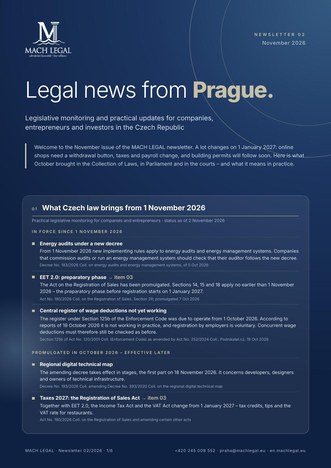
Download the newsletter: Newsletter 02/2026 – Legal news from Prague
The full issue as a PDF, 6 pages – to print or forward.
Download newsletter (PDF)Sources: Czech Collection of Laws (e-Sbírka; zakonyprolidi.cz); history of parliamentary prints 67, 84, 105, 197 and 256; Finanční zpravodaj No. 3/2026; Constitutional Court press releases of 15 and 21 Oct 2026 (usoud.cz); Supreme Court press release of 14 Oct 2026 on headnotes and Collection of Court Decisions, issue 7/2026 (nsoud.cz); CJEU press releases Nos. 132/26 and 147/26 (curia.europa.eu); Podnikatel.cz, 19 Oct 2026; Soudní rozhledy 10/2026.
Status: 2 November 2026. This newsletter is general information and does not replace legal advice on an individual case. Acts not yet promulgated on that date are cited by their parliamentary print; bills may still change in the legislative process.