

For expatriates, foreign executives, and international families residing in the Czech Republic, the dissolution of a marriage represents far more than a personal transition. When your life is distributed across multiple jurisdictions—perhaps holding a marriage certificate from the UK, a diversified investment portfolio in Germany, and a primary residence in Prague—a fundamental and urgent question arises: Which country’s courts will decide your future, and which legal system will dictate the division of your global wealth?
At MACH LEGAL, we understand that standard family law representation is insufficient for cross-border lives. We approach international divorce not merely as a family dispute, but as a critical component of multi-jurisdictional wealth governance.
With the sweeping and historic changes introduced by the 2026 Czech Family Law Amendment, the landscape for international divorce in Prague has fundamentally shifted. For those who act strategically, the new legal framework offers unprecedented speed, privacy, and cost efficiency. Here is the executive overview of what high-net-worth expats must know to secure their assets, protect their families, and maintain their jurisdictional advantage.
1. Jurisdiction: The Race to the Court House (Brussels IIb)
The initial hurdle in any international divorce is determining which court possesses the legal authority (jurisdiction) to hear the case. Within the European Union, this is governed by the newly recast Brussels IIb Regulation (Regulation EU 2019/1111).
You generally have the right to file for divorce in the Czech Republic if:
- Both spouses are currently habitually resident in the Czech Republic.
- The Czech Republic was your last joint habitual residence, and at least one spouse still resides here.
- The respondent (your spouse) is habitually resident in the Czech Republic.
- You are the applicant, and you have been habitually resident in the Czech Republic for at least one year immediately before filing.
The Czech Citizen Exception: If you or your spouse holds Czech citizenship, Czech national law asserts that local courts will always accept jurisdiction over your divorce, even if both of you currently reside permanently outside the European Union.
Strategic Insight — The Lis Pendens Principle: In cross-border marriages, it is highly common for the courts of two different countries to simultaneously possess jurisdiction. Pursuant to Article 20(1) of Council Regulation (EU) 2019/1111 (commonly referred to as Brussels IIb or Brussels IIter), which is currently the fundamental and directly applicable legal instrument for international divorces and parental responsibility within the European Union (with the exception of Denmark), the strict lis pendens (first-in-time) rule applies. The court where the divorce application is formally filed first permanently secures jurisdiction, blocking the other country’s courts from proceeding. Choosing the most favorable jurisdiction requires immediate, tactical analysis to prevent a hostile filing that could lock you into an unfavorable foreign legal system.
2. Applicable Law: Will Czech Courts Apply Czech Law?
Securing jurisdiction in a Czech court does not automatically mean that Czech law will govern the dissolution of your marriage.
A dangerous misconception—and a frequent error made by inexperienced counsel—is the belief that spouses in the Czech Republic can actively choose the law that applies to their divorce under the EU Rome III Regulation. The Czech Republic is not a signatory to the Rome III Regulation. Consequently, Czech courts strictly apply the Czech Act on Private International Law (ZMPS).
Under the ZMPS, a rigid, unalterable „waterfall“ mechanism dictates the law governing your divorce status:
- Common Nationality: The divorce is governed by the law of the state where both spouses hold citizenship, regardless of where they live.
- Habitual Residence: If you hold different passports, the divorce is governed by the law of the state where both spouses share their habitual residence.
- Czech Law (Lex Fori): Only if neither of the above applies will Czech law step in to govern the divorce.
Note on Bilateral Treaties: Certain bilateral treaties, such as the one between the Czech Republic and the Russian Federation, supersede these rules, ensuring that the law of the presiding court applies.
The Untraceable Spouse Dilemma: A common issue for expats is an estranged spouse who has abandoned the marriage, returned to their home country, and cut off all communication. You are not legally trapped. Czech law provides a specific mechanism allowing the court to appoint a legal guardian (typically a separate law firm) to represent the untraceable spouse. Because the guardian cannot formulate factual appeals, this process is generally swift, allowing the divorce to be finalized legally and efficiently.
3. Asset Splitting: The SJM and International Wealth
While the law governing your divorce is rigidly fixed, the law governing your wealth provides room for strategic maneuvering. Under the EU Matrimonial Property Regulation (2016/1103), spouses actually possess the right to choose the law that governs their marital property regime.
If no choice is made, the default Czech property regime applies to expats habitually residing here: the Joint Property of Spouses (Společné jmění manželů or SJM).
What falls into the SJM? By default, almost all assets and liabilities acquired by either spouse during the course of the marriage belong to the SJM, regardless of whose name is on the account. This includes:
- Executive salaries, deferred compensation, and performance bonuses.
- Real estate and investment portfolios acquired globally during the marriage.
- Business shares, stock options (RSUs), and corporate ownership interests.
- Debts and liabilities incurred by either spouse.
What is protected (excluded) from the SJM?
- Assets and wealth acquired prior to the wedding.
- Inheritances and personal gifts received directly by one spouse during the marriage.
- Assets acquired by directly exchanging property that belonged exclusively to one spouse.
The Challenge with Foreign Prenuptial Agreements: Many international couples hold prenuptial agreements drafted in their home jurisdictions (e.g., the US, UK, or Germany). Whether a Czech court will recognize and enforce a foreign prenup depends heavily on EU regulations. Furthermore, to make a foreign property regime fully effective against third-party creditors in the Czech Republic, it is frequently necessary to adapt the agreement into a formal Czech Notarial Deed and register it in the public List of Matrimonial Property Agreements. Assessing the local validity of your foreign wealth-protection structure is our immediate priority.
4. Post-Divorce Financial Support: Spousal Alimony
Unlike some jurisdictions where lifetime alimony is the norm, Czech law does not grant an automatic right to post-divorce spousal support. Alimony is awarded only if a divorced spouse is entirely unable to provide for themselves, and this inability must be directly connected to the marriage.
However, a highly relevant provision exists for expat families—often referred to as the „same standard of living“ alimony. If one spouse sacrificed their career or moved internationally for the marriage, and they did not predominantly cause the marital breakdown, they may petition the court for alimony that guarantees them the same standard of living as their ex-spouse. This exceptional alimony is capped at a maximum of three years post-divorce.
At Mach Legal, we frequently negotiate lump-sum settlements in lieu of ongoing alimony. A lump-sum payment permanently severs financial ties, offering the paying spouse absolute closure and providing the receiving spouse with immediate capital to restart their life in their home country.
Urgent Relief: If an international marriage becomes unbearable due to financial starvation or abusive behavior, Czech law allows for immediate preliminary injunctions. Courts can issue orders guaranteeing essential alimony within 7 days, and police possess the authority to issue immediate 14-day restraining orders evicting hostile partners from the shared residence.
5. The 2026 Advantage: The „Fast-Track“ Consensual Divorce
On January 1, 2026, the Czech Republic enacted historic and revolutionary reforms to its civil family law (Act No. 268/2025 Coll.). These changes created a highly efficient, private, and streamlined path for couples who can successfully negotiate a comprehensive settlement before entering the courtroom.
If spouses agree on the division of their property (SJM) and the care of their children, they can execute a Consensual Divorce (smluvený rozvod). The 2026 law introduced massive advantages for this route:
- No Separation Requirement: The archaic and frustrating requirement to prove you have lived apart for six months has been completely abolished. Spouses can transition immediately.
- Absolute Privacy (No „Dirty Laundry“): The court applies an „irrebuttable presumption of breakdown.“ Judges are explicitly prohibited from interrogating spouses about the intimate causes of the marriage failure (e.g., infidelity or personal grievances). Your private life remains strictly off the public record.
- Merged Proceedings: Previously, divorces involving children required two separate, lengthy, and expensive court cases. As of 2026, child custody, asset division, and the divorce itself are handled by a single judge in one unified, fast-tracked court proceeding.
- Unified Custody Concept: The combative legal labels of „sole“ or „alternating“ custody have been eliminated. They are replaced by a unified, cooperative concept of „parental custody,“ diffusing tension and protecting children from legal crossfire.
- Lower Court Fees: To incentivize amicable agreements, the state dramatically reduced the court fee for consensual divorces to just 2,000 CZK, while penalizing contested divorces with a higher 5,000 CZK fee.
Conversely, a contested divorce (sporný rozvod) remains a prolonged, public, and costly legal battle, subject to exhaustive evidentiary hearings required to map and value hidden international assets.
6. The Czech-German Corridor: A Specialized DACH Approach
If your marriage, asset portfolio, or corporate interests span the border between the Czech Republic and Germany, the legal complexity multiplies exponentially. The friction between the German Zugewinngemeinschaft (community of accrued gains) and the Czech SJM requires highly specialized navigation.
As a boutique law firm possessing unique dual Czech-German legal qualifications, MACH LEGAL is exceptionally positioned to handle DACH-region cross-border divorces. Dr. Tomas Mach serves as a sworn court expert in German law within the Czech Republic. We operate seamlessly across both legal jurisdictions, eliminating the massive expense and logistical nightmare of retaining, coordinating, and paying two separate international law firms.
Secure Your Strategic Jurisdictional Advantage
Cross-border divorces demand more than a standard family lawyer; they require a multi-jurisdictional strategist. Whether you seek to execute a rapid, private consensual divorce under the new 2026 legal frameworks, or require aggressive asset protection against a hostile international filing, Mach Legal provides the sophisticated legal architecture your global lifestyle demands.
Are you facing a cross-border family transition? Do not wait for your spouse to seize the jurisdictional advantage. Contact MACH LEGAL today for a highly discreet, expert consultation to map out your strategic options, protect your wealth, and secure your future.
Works cited
- Divorce of an international marriage – Stuchlíková & Partners, accessed July 8, 2026, https://www.stuchlikova.com/en/blog/2023/divorce-of-an-international-marriage/
- Which country’s law applies? | European e-Justice Portal, accessed July 8, 2026, https://e-justice.europa.eu/topics/taking-legal-action/where-and-how/which-countrys-law-applies/cz_en
- Divorce in 2026: New Divorce Rules and Child Custody in Czech …, accessed July 8, 2026, https://www.ecovislegal.cz/en/other-legal-areas/divorce-in-2026-new-rules-for-divorce-and-child-custody/
- O nás – Německé právo v Česku, accessed July 8, 2026, https://www.nemeckepravo.cz/?page_id=8
- Německé právo v Česku, accessed July 8, 2026, https://www.nemeckepravo.cz/
- Law applicable to divorce and legal separation regulation – Wikipedia, accessed July 8, 2026, https://en.wikipedia.org/wiki/Law_applicable_to_divorce_and_legal_separation_regulation
- The law applicable to legal separation and divorce – Aldricus, accessed July 8, 2026, https://aldricus.giustizia.it/the-law-applicable-to-legal-separation-and-divorce/?lang=en
- International divorce law – Federal Foreign Office, accessed July 8, 2026, https://www.auswaertiges-amt.de/en/international-divorce-law-2683968
- UNIVERZITA KARLOVA Rozvod manželství s mezinárodním prvkem se zaměřením na česko-slovenské rozvody manželství, accessed July 8, 2026, https://dspace.cuni.cz/bitstream/handle/20.500.11956/194531/120483031.pdf?sequence=1&isAllowed=y
- UNIVERZITA KARLOVA V PRAZE PRÁVNICKÁ FAKULTA Volba rozhodného práva v mezinárodním právu soukromém, accessed July 8, 2026, https://dspace.cuni.cz/bitstream/handle/20.500.11956/82036/DPTX_2014_1_11220_0_354077_0_158661.pdf?sequence=1&isAllowed=y
- czech private international law | is muni, accessed July 8, 2026, https://is.muni.cz/publication/1340205/Czech_Private_International_Law.pdf
- Expat divorce in the Czech Republic: Court … – Tomáš Gawron, accessed July 8, 2026, https://gawron.cz/expat-divorce-in-the-czech-republic-court-jurisdiction-and-governing-law-of-divorce-proceedings/
- Brussels IIb Regulation – Aldricus, accessed July 8, 2026, https://aldricus.giustizia.it/wp-content/uploads/2022/09/Practice-Guide-for-the-application-of-the-Brussels-IIb-Regulation_EU_EN.pdf
- EU AND PRIVATE INTERNATIONAL LAW: OPEN QUESTIONS IN FAMILY LAW, CONTRACTS, AND TORTS – Editoriale Scientifica, accessed July 8, 2026, https://editorialescientifica.it/wp-content/uploads/2025/07/EBOOK-Heiderhoff-Queirolo_EU-and-Private-International-Law_2025_ISBN-979-12-235-0304-1.pdf
- STUDY – Parental Child Abductions to Third Countries – European Union, accessed July 8, 2026, https://www.europarl.europa.eu/RegData/etudes/STUD/2024/759359/IPOL_STU(2024)759359_EN.pdf
- How to divorce from abroad – Dostupný advokát, accessed July 8, 2026, https://dostupnyadvokat.cz/en/blog/divorce-from-abroad
- Czech Republic Family Laws and Regulations 2026 – ICLG, accessed July 8, 2026, https://iclg.com/practice-areas/family-laws-and-regulations/czech-republic/
- Matrimonial and parental judgments: jurisdiction, recognition and enforcement (Brussels IIa), accessed July 8, 2026, https://eur-lex.europa.eu/EN/legal-content/summary/matrimonial-and-parental-judgments-jurisdiction-recognition-and-enforcement-brussels-iia.html
- EU Matrimonial Property Regime Regulation – International Family Law Group – UK.COM, accessed July 8, 2026, https://iflg.uk.com/blog/eu-matrimonial-property-regime-regulation
- Couples in Europe – CNUE, accessed July 8, 2026, https://www.notariesofeurope.eu/en/citizens/couples-in-europe/
- COUNCIL REGULATION (EU) 2016/ 1103 – of 24 June 2016 – implementing enhanced cooperation in the area of jurisd – EUR-Lex – European Union, accessed July 8, 2026, https://eur-lex.europa.eu/legal-content/EN/TXT/PDF/?uri=CELEX:32016R1103
- Couples in Czech Republic – CNUE, accessed July 8, 2026, https://www.notariesofeurope.eu/en/faq5/couples-in-europe/couples-in-czech-republic/
- CROSS-BORDER COUPLES PROPERTY REGIMES IN ACTION BEFORE COURTS, accessed July 8, 2026, https://www.euro-family.eu/documenti/risultati/eu_fampro_case_book.pdf
- European regulation on matrimonial property regimes Council Regulation (EU) 2016/1103 of 24 June 2016 – EUBF, accessed July 8, 2026, https://eubf.eu/wp-content/uploads/2023/07/03-Regulation-2016-1103-EN-1.pdf
- Marriage / prenuptial contracts – gov.cz – Portál veřejné správy, accessed July 8, 2026, https://portal.gov.cz/en/sluzby-vs/marriage–prenuptial-contracts-S8629
- Smluvený rozvod a péče obou rodičů – co přinesla novela rodinného práva, accessed July 8, 2026, https://vasulinova.cz/blog/smluveny-rozvod-novela-2026/
- Méně sporů rodičů a větší klid pro děti. Jak se mění rozvody Čechů – Peníze.cz, accessed July 8, 2026, https://www.penize.cz/spotrebitel/484258-rozvody-cechu-se-meni-novela-slibuje-mene-sporu-rodicu-a-vetsi-klid-pro-deti
- Rozvodová novela – Ministerstvo spravedlnosti České republiky – Portál justice, accessed July 8, 2026, https://msp.gov.cz/web/msp/rozvodov%C3%A1-novela
- Rozvod bude jednodušší a bez zbytečných formalit. Co všechno se od ledna 2026 mění?, accessed July 8, 2026, https://dostupnyadvokat.cz/blog/rozvod-bude-jednodussi
- Succession regulation – scope and jurisdiction – ERA, accessed July 8, 2026, https://www.era-comm.eu/Visegrad/kiosk/pdf/speakers_contributions/117Dt06_Margonski_succession.pdf
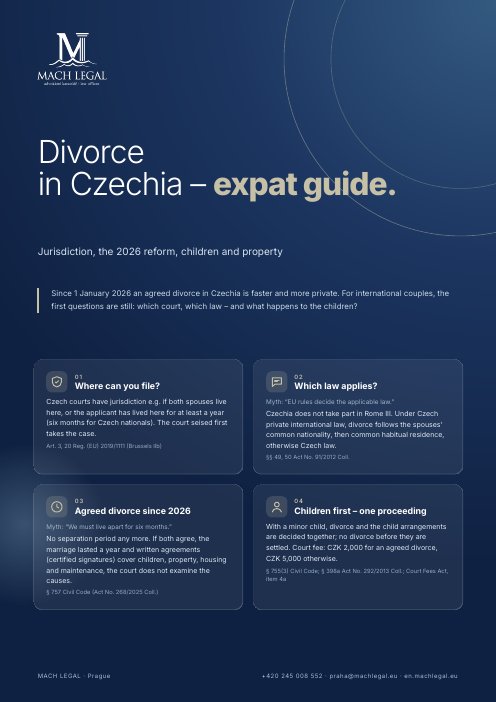
Free guide: Divorce in Czechia – expat guide
Jurisdiction, the 2026 reform, children and property. PDF, 2 pages.
Download the guide (PDF)