

Finding a great apartment in Prague or Brno is only half the battle. For expats relocating to the Czech Republic, signing the lease agreement is where the real risks begin. Language barriers and unfamiliarity with the Czech Civil Code often lead foreign tenants to sign contracts containing unfair conditions, unlawful fees, or terms that put their security deposits at risk.
To help you secure your new home safely, we have compiled the ultimate legal checklist for renting property in the Czech Republic. Here are the most critical red flags to watch out for before you sign.
1. The Crucial Difference: Nájem vs. Podnájem
One of the biggest traps for expats hides in the very title of the contract. You must always check whether you are signing a Lease Agreement (Nájemní smlouva) or a Sublease Agreement (Podnájemní smlouva).
They sound similar, but your legal rights are drastically different:
- Nájem (Lease): You are renting directly from the property owner. You are heavily protected by the Czech Civil Code.
- Podnájem (Sublease): You are renting from another tenant, not the owner. In a sublease, you have significantly fewer rights and almost no legal protection against sudden eviction. If the primary tenant’s lease ends, your sublease ends automatically. Furthermore, if the owner did not give written consent for the sublet, your contract is invalid.
2. The Security Deposit (Kauce) and Your Hidden Right to Interest
Landlords typically require a security deposit (legally referred to as jistota). By law, this deposit cannot exceed three times the monthly rent.
However, there is a major rule that most expats—and even many landlords—do not know: You are legally entitled to receive interest on your security deposit for the entire duration the landlord holds your money. Under the Czech Civil Code, the landlord must return your deposit along with interest at the statutory rate (or an agreed-upon higher rate) at the end of the lease. If the landlord includes a clause in your contract stating that the deposit „does not accrue interest,“ that specific clause is entirely invalid and legally unenforceable.
3. Watch Out for Illegal „Banned“ Fees
When reviewing your contract, ensure that your base rent (nájemné) is strictly separated from your utility and service advance payments (služby).
Some landlords try to secretly pass their own ownership costs onto the tenant. A landlord cannot legally force you to pay into the building’s „repair fund“ (fond oprav) or make you pay for the building’s general insurance as part of your utility bill. These are the costs of ownership and must be factored into the base rent, not charged as separate fees.
4. Invalid Contract Clauses: Pets and Permanent Residence
The Czech Civil Code is highly pro-tenant. Even if you sign a lease containing certain restrictive rules, these clauses are automatically void if they restrict your basic rights.
- „No Pets Allowed“: A landlord cannot legally ban you from keeping a pet in the apartment, provided the animal does not cause a disproportionate burden to the property or the neighbors.
- „No Permanent Residence Registration“: Landlords often try to forbid expats from registering the apartment as their official permanent or temporary residence (trvalý pobyt / přechodný pobyt). Such bans are legally ineffective. You have the right to register your residence at the foreign police or Ministry of Interior simply by presenting a valid lease agreement, regardless of what the landlord writes in the contract.
5. Getting Your Deposit Back
To ensure you get your deposit back in full, always insist on a detailed Handover Protocol (předávací protokol) when moving in and moving out. This document should record the exact state of the utility meters and detail any existing damages. While the law does not specify a strict deadline, a well-drafted contract should state that the deposit must be returned within a specific timeframe (e.g., 15 to 30 days) after moving out. The landlord can only deduct money for unpaid rent, unpaid utility bills, or actual damage beyond normal wear and tear.
Do Not Sign Without a Legal Review
Your housing contract dictates your life in the Czech Republic. Because standard Czech lease agreements heavily rely on local legal terminology, trying to navigate them via automated translators is a massive risk.
At MACH LEGAL, we help expats and international professionals secure their housing safely. We provide comprehensive, English-speaking legal reviews of lease agreements, negotiate terms with landlords, and ensure that your rights and your security deposit remain fully protected.
Before you pay your deposit, contact MACH LEGAL to have your lease reviewed by an expert.
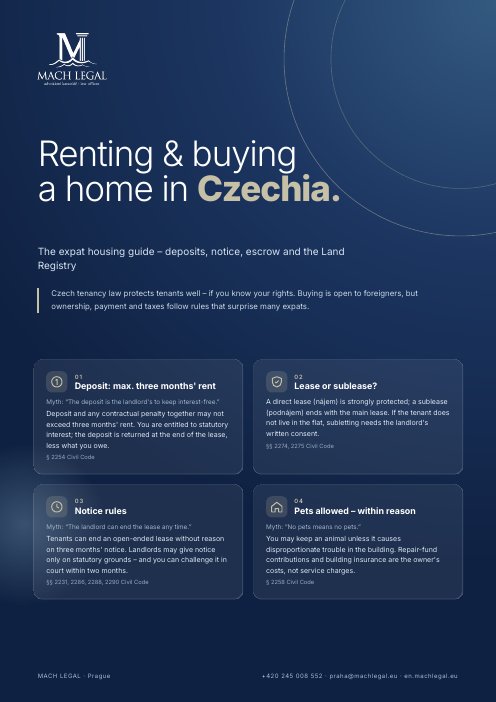
Free guide: Renting & buying a home in Czechia
Deposits, notice, escrow and the Land Registry. PDF, 2 pages.
Download the guide (PDF)