
Buying real estate in the Czech Republic, particularly in Prague, is highly attractive for expats, digital nomads, and foreign investors. However, purchasing an apartment or a house in a foreign country involves navigating a complex legal system, a language barrier, and unfamiliar bureaucratic hurdles.
If you are considering investing in the Czech real estate market, here is the ultimate guide to understanding your rights, the purchasing process, and the critical legal traps you must avoid.
1. Are there any restrictions on foreigners buying property?
The short answer is no. Unlike some other European countries, the Czech Republic does not impose nationality-based restrictions on buying real estate.
Both EU and non-EU citizens can legally purchase property just as easily as locals. You do not need to hold a permanent residency permit, nor are you required to establish a local business entity (such as an s.r.o.) to make a purchase. The market is fully open to international buyers.
2. The Golden Rule: Never send money directly to the seller
One of the most dangerous mistakes foreign buyers make is sending the purchase price directly to the seller’s bank account upon signing the contract.
Under Czech law, signing a purchase agreement does not make you the legal owner of the property. The transfer of ownership only takes effect once you are officially registered as the new owner in the Land Registry (Katastr nemovitostí),. This registration process involves a mandatory 20-day protection period and typically takes several weeks to complete.
If you send the money directly and the registration fails—or if the seller is fraudulent—you could lose your funds entirely. To protect yourself, always use an Attorney Escrow (advokátní úschova). The purchase funds are safely held in an independent escrow account managed by your lawyer, and the money is only released to the seller after the Land Registry confirms you are the official owner,.
3. Legal Due Diligence: Do not rely solely on the real estate agent
Real estate agents are motivated to close the deal. As a buyer, it is your responsibility to conduct thorough legal due diligence before signing a reservation agreement.
Your lawyer must investigate the property in the Cadastral Register to ensure the seller is the actual owner and that the property is free from legal defects,. This includes checking for hidden debts, foreclosures, pledges, or third-party rights (easements) that could encumber the property,.
4. The Marital Property Trap (SJM)
If you are married, buying property in the Czech Republic triggers specific family law rules that many expats overlook. By default, any real estate acquired during the marriage falls into the Joint Property of Spouses (Společné jmění manželů or SJM), [].
Even if you pay for the property from your own bank account and only your name is on the purchase agreement, the property is generally still considered jointly owned by you and your spouse. If you wish to purchase the property solely for yourself, or if you have a foreign prenuptial agreement, you will likely need to adjust your marital property regime through a formal Czech Notarial Deed before completing the transaction or structure the SPA in a way to exclude the triggering of the SJM regime.
5. Mortgages and Financing for Expats
Czech banks do offer mortgages to foreigners, and you do not necessarily need permanent residency; many banks will accept an employee card. However, the conditions are stricter:
- Downpayment: While locals might secure higher financing, non-residents or foreign buyers are often required to provide a downpayment of 20% to 40% of the property value. Buyers under the age of 36 typically need at least a 10% downpayment, while older buyers need a minimum of 20%.
- Income Verification: You must prove a stable income (often for the last 6 to 12 months), and your mortgage repayments generally cannot exceed 50% of your net monthly household income,.
6. Property Taxes and Hidden Costs
The good news is that the Czech Republic abolished the 4% real estate transfer tax, making property acquisition significantly cheaper. However, you must be aware of other tax obligations:
- Annual Property Tax: Once you become an owner, you are required to pay a relatively low annual property tax,.
- Rental Income Tax: If you rent out the property, your rental income is subject to a 15% (or 23%) income tax in the Czech Republic, even if you reside abroad.
- Capital Gains Tax (The 10-Year Rule): If you decide to sell the property, the profit is subject to income tax (15% or 23%). However, you are exempt from this tax if you hold the property for more than 10 years (for properties acquired after January 1, 2021) or if you use the funds from the sale to cover your own housing needs,,.
Secure Your Czech Real Estate Investment
Buying property should be an exciting milestone, not a legal nightmare. Because all official contracts and Land Registry submissions must be in Czech, proceeding without independent legal representation is highly risky.
At MACH LEGAL, we specialize in protecting the investments of expats and foreign executives. We provide comprehensive English and German-speaking legal support, including deep due diligence, drafting bilingual contracts, and providing secure attorney escrow services.
Contact us today to ensure your real estate purchase in the Czech Republic is safe, legally binding, and completely stress-free.
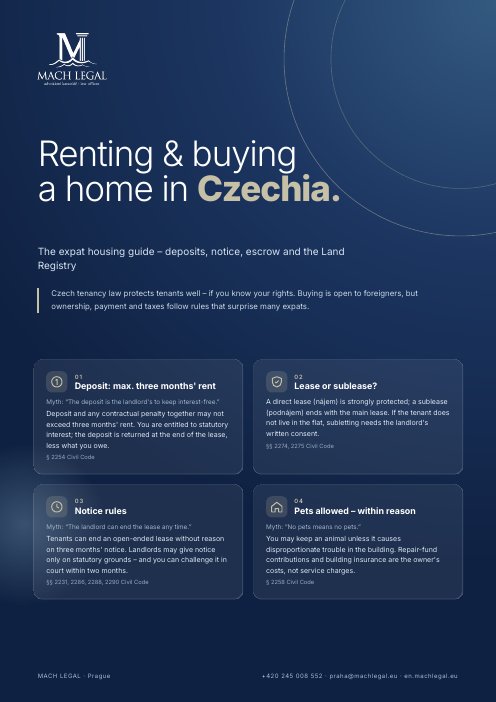
Free guide: Renting & buying a home in Czechia
Deposits, notice, escrow and the Land Registry. PDF, 2 pages.
Download the guide (PDF)