

In recent months, there has been a growing trend of employee requests to work from home (home office) or—especially during the summer months—from abroad (so-called workation). Although this working arrangement may represent an attractive benefit for employees, it entails a number of legal, tax, and administrative risks for employers.

Therefore, if you, as an employer, are considering allowing your employees to work from home or from abroad, we recommend keeping the following key aspects in mind:
1. Social Security and Health Insurance (A1 Form)
This is the most critical area. Within the EU, the rule is that an employee is subject to the social security legislation of only one Member State.
First and foremost, it must always be determined where the employee performs a substantial part of their activity. This means determining where a quantitatively substantial part of all the worker’s activities is carried out, with the defining threshold being 25% and the evaluation criteria being working time and/or remuneration. However, other criteria may also be taken into account.
Thus, if an employee performs a substantial part of their activity (25% of working time or 25% of remuneration) in their country of residence, they must be insured in their country of residence. Conversely, if an employee who normally works in the Czech Republic goes abroad to work for 3 months in the summer, they can easily exceed the time limit there, which would create an obligation for the employer to register for contributions abroad and pay the local (often higher) insurance premiums.
For the legal posting or concurrent activities of an employee, it is essential to ask the Czech Social Security Administration to issue an A1 Certificate (Application for the determination of applicable legislation). Without it, both the employee and the employer face steep fines in the event of an inspection abroad.
In countries outside the European Union, the situation is even more complex and is governed by bilateral treaties. If no such treaty exists for a given state, there is a risk of double payment of insurance premiums.
- Tax Aspects and the Risk of Creating a „Permanent Establishment“
If an employee works from abroad for a longer period of time, there is a risk that they will create a so-called permanent establishment for the employer in that country. This would mean that a portion of the employer’s profits could be taxed in the respective foreign state.
At the same time, the issue of personal income tax arises, where it is realistic that an employee working abroad will exceed the 183-day limit for determining their tax domicile, at which point the employer may become liable for income tax in a foreign jurisdiction.
- Occupational Health and Safety
In accordance with the Labor Code (Act No. 262/2006 Coll.), the employer is responsible for the occupational health and safety of the employee even when the individual is working on a so-called home-office basis.
The employer has a duty to ensure that the employee’s workplace is safe. If the employee works from home, fulfilling this obligation is relatively difficult for the employer. When work is performed from abroad, ensuring the oversight and safety of the employee is practically impossible.
In the event of an injury, whether it occurs during home-office or while working abroad, it will be very difficult to prove that it is actually a workplace injury. Furthermore, insurance companies often resist paying claims in these cases, citing a breach of preventative duties.
- Minimum Wage and Mandatory Rules
Even if the employee has an employment contract concluded under Czech law, while working from abroad, their work will be governed by the rules governing their employment relationship, but simultaneously by at least those rules for performing work in the given state that are more favorable to the employee (according to the EU Posting of Workers Directive).
This means that if there is a higher minimum wage or a longer mandatory rest period in the given country (e.g., in Germany or Austria), the employer must match these conditions for the duration of the work abroad.
Possible Risks for Employers
- Administrative burden: The necessity to study the laws of foreign countries and communicate with local authorities.
- Financial penalties: The risk of fines for failing to report the employee’s work from abroad, as well as supplementary assessments of insurance premiums.
- Cybersecurity: Working from public Wi-Fi networks in hotels, for example, increases the risk of corporate data leaks.
How Employers Can Proceed
Whether the employer decides to reject employee requests for home-office or work from abroad, or wishes to keep them under control, we recommend the following procedure:
- Internal regulation (home-office directive): The employer should create a detailed internal regulation governing this area of work performance. It should explicitly state that home-office is permitted only within the territory of the Czech Republic, specifically at the address that the employee has reported to the employer in writing for this purpose. Working from abroad will be defined as a breach of workplace discipline by the employee, for which appropriate penalties apply in accordance with the provisions of the Labor Code.
- Addendum to the employment contract: If the employer wishes to accommodate a particular employee’s request despite the associated risks, we recommend negotiating an individual addendum to the employment contract. This should explicitly and precisely define the period for which the home-office/work from abroad is agreed upon (e.g., a maximum of 14 days per year). At the same time, the employee shall declare in writing that the workplace where the work will be performed meets all statutory occupational health and safety requirements. The employee will also commit in writing to covering all costs associated with potential tax/insurance levies abroad.
- Technical barrier: The employer can set up IT restrictions (VPN) that will prevent logging into corporate systems from IP addresses outside the Czech Republic without prior approval.
Conclusion
For the normal operations of a Czech employer, a blanket authorization of work from abroad is highly risky. Likewise, allowing work on a home-office basis presents certain challenges for the employer (especially in terms of occupational health and safety).
We recommend emphasizing in internal communications that the main reason for restricting or directly prohibiting work from abroad is the strict EU tax and insurance regulations, the compliance with which the employer cannot guarantee across dozens of different countries.
Regarding home-office, we recommend highlighting the risks associated with performing work in a home or similar environment, where it is difficult for the employer to ensure optimal conditions and the employee’s safety.
If, despite the above, the employer decides to permit home-office from abroad in certain cases, it is necessary to consult with an attorney licensed (and thus insured) in the relevant jurisdiction for that specific case. Our law firm provides this service in the Czech Republic, Germany, and Slovakia, and is ready, through international cooperation, to connect our colleagues with counterparts in other relevant jurisdictions, whether in Europe or overseas.
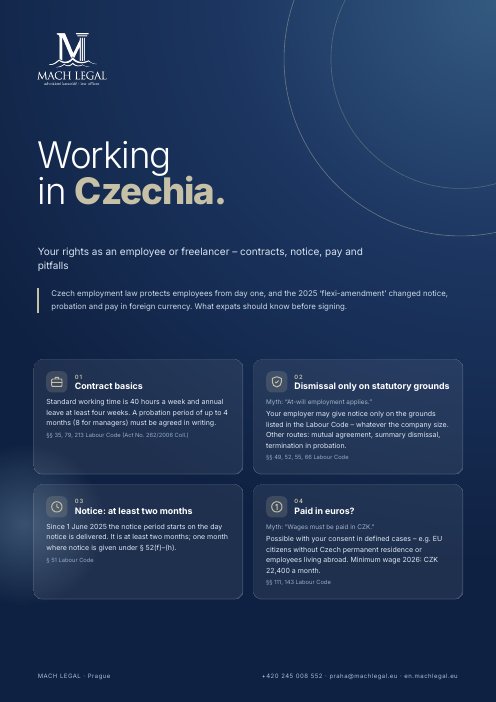
Free guide: Working in Czechia
Your rights as an employee or freelancer – contracts, notice, pay and pitfalls. PDF, 2 pages.
Download the guide (PDF)